






mDOT Center Renewed for Five Years to Advance the Next Generation of Mobile Health Technologies
The mDOT Biomedical Technology Resource Center has been renewed for an additional five years of support from the National Institutes of Health’s National Institute of Biomedical Imaging and Bioengineering (NIBIB), marking an exciting new chapter for the Center and its national community of investigators, collaborators, trainees, and research partners.
The renewal builds upon the scientific foundation established by mDOT to advance the discovery, optimization, and translation of temporally precise mobile health (mHealth) interventions. Over the next five years, the Center will expand this vision by bringing together advances in wearable sensing, biosignal foundation models, generative AI, reinforcement learning, personalization, and resource-efficient computing to enable a new generation of intelligent and adaptive mobile health technologies.
Building the Next Generation of Temporally Precise Interventions
The next phase of the mDOT Center will advance an integrated research agenda across its three Technology Research and Development (TR&D) projects.
- TR&D1 – Discovery will advance methods for understanding an individual’s changing state and context through biosignal foundation models and generative AI. Building on technologies developed through the Center, this work will develop new approaches for identifying health risk factors from multimodal data and generating trustworthy, context-aware intervention content.
- TR&D2 – Optimization will develop methods for determining how interventions can be personalized and adapted over time. Building on the Center’s work in reinforcement learning and technologies such as pJITAI, researchers will develop approaches that learn from an individual’s responses, preferences, and changing circumstances to help determine what intervention should be delivered and when.
- TR&D3 – Translation will transform these advances into practical technologies capable of operating in real-world settings. Research will focus on resource-efficient computing, lightweight wearable biomarkers, digital twins, and trustworthy AI approaches that can bring increasingly sophisticated sensing and intervention capabilities to everyday mobile and wearable devices.
Together, these efforts represent an ambitious progression from sensing and understanding what is happening in an individual’s life to determining what intervention to deliver, when to deliver it, and how to personalize it over time.
Impact Through Collaboration and Research Translation
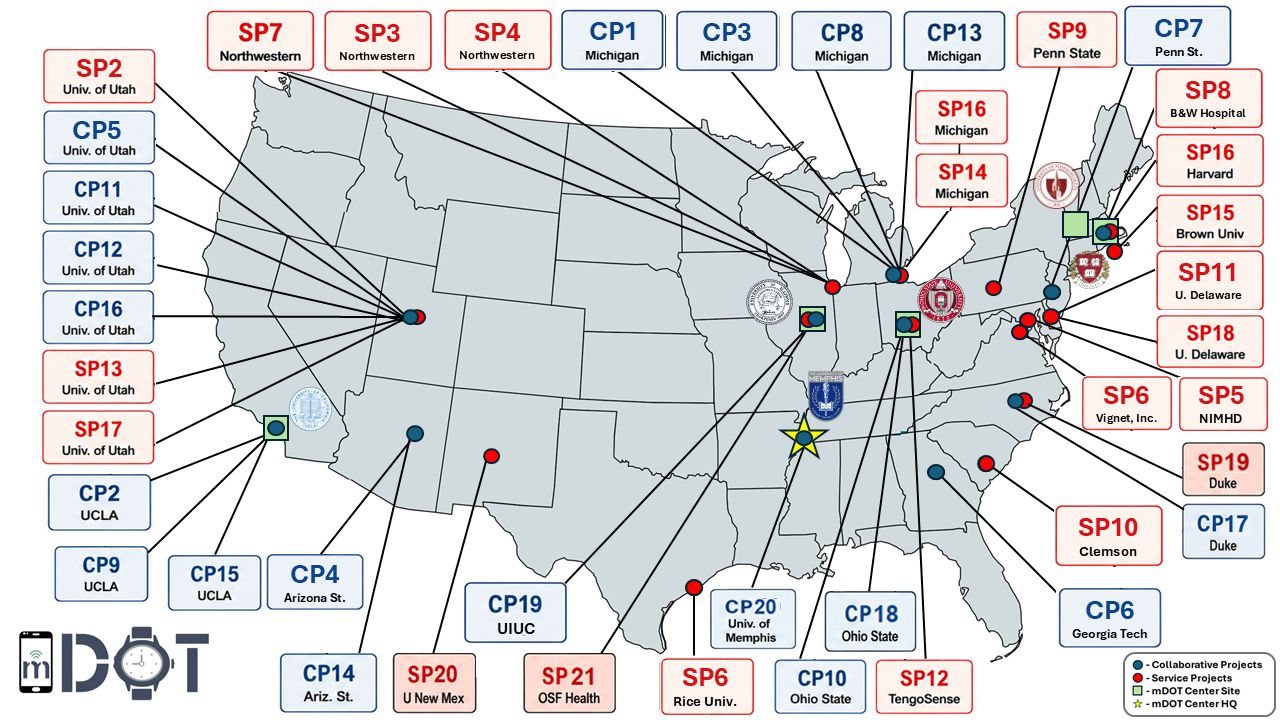
A defining feature of the mDOT Center is its commitment to extending its research beyond the Center itself. Through collaborations with independently funded investigators, nationwide Collaborative Projects (CPs) and Service Projects (SPs), and a growing community of researchers using mDOT technologies, the Center works to ensure that its methods and infrastructure can be applied to important real-world health challenges.
During its first five years, the Center’s research community produced 187 publications, 15 technology releases, 20 GitHub repositories, and four open datasets, while the TR&D projects trained 36 students across multiple levels. These accomplishments reflect the collaborative contributions of faculty, students, postdocs, staff, advisors, and research partners across the Center.
The Center’s Training and Dissemination activities further extend this impact through the mHealth Training Institute (mHTI) and mHealthHUB, providing researchers with opportunities to learn about emerging methods, technologies, and approaches in mobile and digital health. Together, these resources have helped make mDOT-developed knowledge and tools accessible to a much broader research community.
Research Tools Available to the Community
A central mission of the mDOT Center is to ensure that the technologies developed through its research are available to scientists beyond the Center itself.
The mDOT Center Digital Toolbox provides the broader research community with access to a growing collection of open and reusable technologies, software, models, datasets, and educational resources developed through the Center. Current resources include technologies for wearable sensing and digital biomarkers, physiological signal modeling and imputation, reinforcement learning and personalized interventions, mobile health study development, and real-world data collection.
Many of these resources, including Pulse-PPG, PulseImpute, BayesLDM, pJITAI, and other mDOT technologies, are available now for researchers to explore and incorporate into their own studies, collaborations, and grant applications.
During the next five years, mDOT will continue expanding the Digital Toolbox, supporting adoption of Center-developed technologies, and creating new opportunities for researchers to collaborate with mDOT investigators and apply these resources to important problems in health and behavior.
Looking Ahead
As the Center enters its next five years, mDOT will continue pursuing collaborative and innovative research that enables the development of increasingly powerful biosignal foundation models and intelligent mobile health technologies. These advances will support new ways of detecting relevant health risk factors and identifying how best to support individuals within their unique time and context.
Underlying this work is the transdisciplinary collaboration that has defined the mDOT Center from its beginning. By bringing together expertise across computer science, engineering, behavioral science, statistics, medicine, and mobile health, the Center will continue working toward technologies that are increasingly intelligent, adaptive, personalized, trustworthy, and deployable in everyday life.
“This renewal is a recognition of what we have built together and an opportunity to shape the next generation of mobile health research. Over the next five years, we want to move beyond simply sensing what is happening in an individual’s life toward technologies that can understand those signals, determine when support is needed, and deliver interventions that adapt to each individual over time.”
— Santosh Kumar, Ph.D. Director, mDOT Biomedical Technology Resource Center
Join the mDOT Research Community
The mDOT Center welcomes researchers from across the United States and beyond to explore its technologies, resources, and opportunities for collaboration.
Researchers are invited to explore the mDOT Center Digital Toolbox and discover technologies, software, datasets, and educational resources that can be used in new studies, collaborations, and grant applications. As the Center enters its next five years, mDOT looks forward to expanding these resources and working with the broader research community to build the future of wearable AI and temporally precise mobile health.