






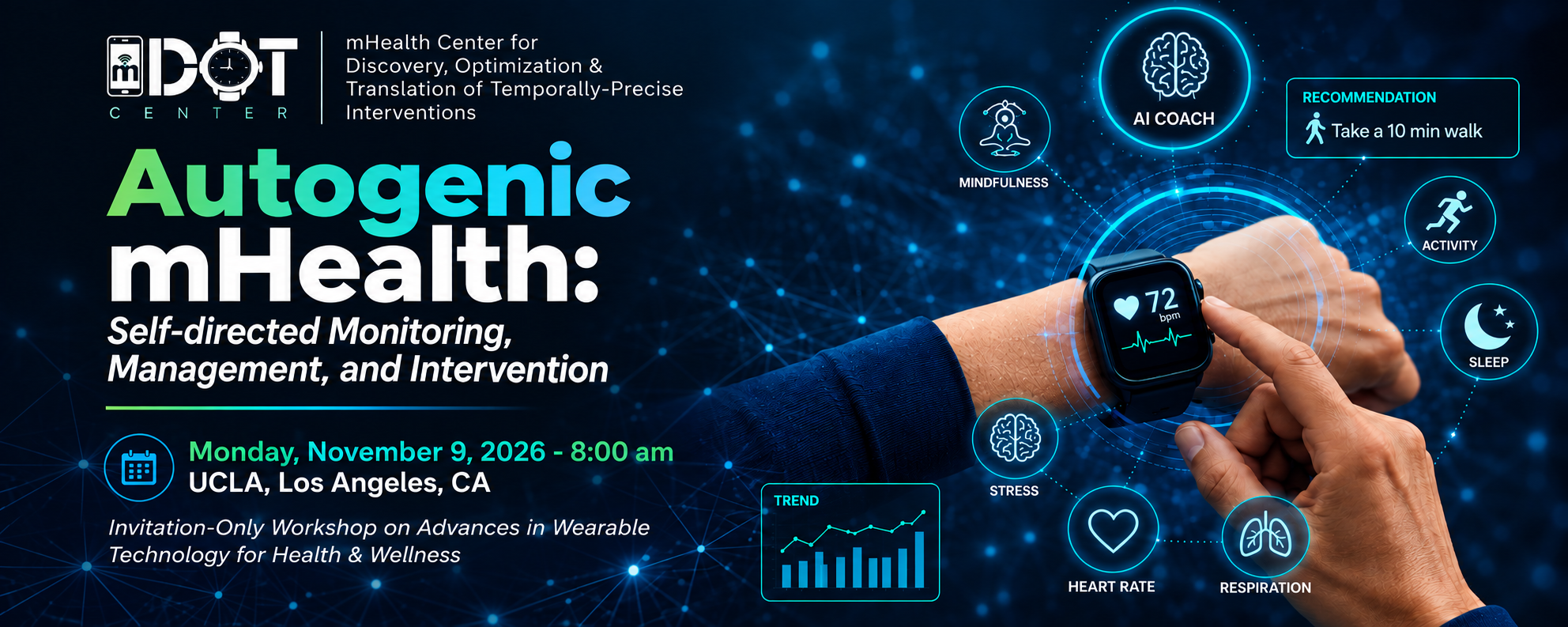
Visioning Workshop – Autogenic mHealth hosted by mDOT Center this November
This workshop will bring together a select group of researchers from behavioral science, artificial intelligence, mHealth, sensing, clinical medicine, and human-computer interaction to explore how recent advances in biosignals, multimodal sensing, foundation models, generative AI, digital twins, and agentic AI could transform how people monitor, understand, and manage their health. The workshop will examine the emerging paradigm of Autogenic mHealth, in which intelligent systems work in partnership with individuals to support self-directed health management and personalized interventions.
Over the past fifteen years, mHealth has evolved from sensing and sense-making to triggering just-in-time interventions. Wearable sensors and AI-powered biomarkers have enabled researchers to better understand health and behavior in everyday settings, while advances in personalization have helped optimize the timing and content of interventions. Autogenic mHealth represents a further evolution: a shift from expert-driven interventions toward participant-driven health management, where individuals actively use intelligent systems to interpret their own data, understand patterns in their health and behavior, explore potential strategies, and adapt their approach over time.
Recent advances in mobile and wearable sensing, multimodal learning, foundation models, and generative AI are creating new opportunities to integrate physiological signals, behavioral observations, and contextual information across time and modalities. These technologies could enable AI systems to move beyond detecting patterns or delivering predefined recommendations toward developing a more comprehensive understanding of each individual, incorporating scientific and clinical knowledge, and supporting personalized decision-making. Combined with digital twins and agentic AI, these capabilities may enable continuous cycles of monitoring, reasoning, experimentation, and adaptation that help individuals make informed decisions about their health in their everyday environments.
The workshop will explore the scientific foundations, technological opportunities, and practical challenges of realizing this vision. Discussions will address the health problems and populations that could benefit most from Autogenic mHealth, the capabilities needed to connect sensing and AI-driven reasoning with personalized interventions, and the methodological and ethical considerations necessary to ensure these systems are safe, effective, and responsible. By bringing together complementary expertise across health and technology, the workshop aims to establish a shared research agenda and foster collaborations to advance the next generation of personalized, self-directed digital health.
For more information please head to the mDOT Center Autogenic Workshop page:
https://mdotcenter.org/news-events/events/autogenic-mhealth-workshop/https://mdotcenter.org/news-events/events/mhealth-meets-brain-workshop/
Workshop Objectives:
Autogenic mHealth is an emerging paradigm for personalized digital health in which individuals work continuously with intelligent systems to monitor, understand, and manage their own health. Rather than relying solely on expert-designed and delivered interventions, Autogenic mHealth shifts toward participant-driven health management, with AI-enabled systems interpreting personal physiological, behavioral, and contextual data while incorporating scientific and clinical knowledge to support individualized decisions.
Advances in biosignals, multimodal sensing, foundation models, generative AI, digital twins, and agentic AI are creating the technological foundation for this shift. These capabilities can enable systems to move beyond passive monitoring and static recommendations toward continuous partnerships that help individuals discover what to monitor, understand patterns in their health and behavior, explore potential strategies, and learn from the results over time.
At its core, Autogenic mHealth represents a shift from expert-driven intervention to participant-driven self-management:
Monitor → Understand → Explore → Act → Learn → Adapt
The goal is not to replace researchers or clinicians, but to extend scientific and clinical knowledge into an ongoing partnership with individuals, enabling more informed, personalized, and adaptive health decisions in everyday life.
Traditional mHealth has largely centered on interventions designed by experts and delivered to individuals. Researchers and clinicians typically identify what should be measured, determine the desired outcome, develop an intervention, and establish when and how it should be delivered. Even personalized approaches generally operate within a framework defined in advance.
Autogenic mHealth shifts this model toward participant-driven health management. Instead of simply receiving predetermined recommendations or interventions, individuals work with intelligent systems to understand their own health, identify meaningful patterns, explore potential strategies, and learn from their experiences. The system continuously integrates personal data with scientific and clinical knowledge, allowing the process to evolve as the individual’s goals, context, and health change.
This represents a shift from:
Expert-driven → Participant-driven
Predetermined interventions → Self-directed strategies
Static recommendations → Continuous learning
Passive monitoring → Active understanding
Intervention delivery → Ongoing health partnership
The distinction is fundamental: Autogenic mHealth is not simply about making existing interventions more intelligent. It is about enabling individuals to become active participants in the process of discovering, understanding, and managing their own health.
The workshop will explore the emerging frontier of Autogenic mHealth and its potential to transform personalized digital health. Participants will examine how biosignals, multimodal sensing, foundation models, generative AI, digital twins, and agentic AI can work together to create intelligent systems that continuously learn from an individual’s physiological, behavioral, and contextual data. Particular attention will be given to how these technologies can move beyond passive monitoring and static recommendations toward systems that actively support individuals in understanding and managing their own health.
The workshop will identify opportunities and challenges associated with moving from expert-driven interventions to participant-driven self-management. Participants will explore how intelligent systems might help individuals discover what to monitor, understand relationships between behavior and physiology, evaluate potential strategies, and adapt their approach over time. Discussions will also examine the scientific and practical challenges involved in translating this vision into effective and usable systems, including the interpretation of complex multimodal data, personalization, continuous learning, and integration of scientific and clinical knowledge.
The workshop will address the ethical, methodological, and technical challenges associated with enabling individuals to use intelligent systems to make decisions about their own health. Discussions will consider issues of privacy, autonomy, consent, trust, transparency, safety, and responsible use of AI in systems that continuously interpret personal health data and provide individualized guidance. Participants will also examine technical challenges associated with reliable sensing, multimodal data integration, model reasoning, personalization, adaptation, and the safe deployment of increasingly autonomous AI systems in real-world health settings.
A pivotal goal of the workshop is to develop a strategic research roadmap for Autogenic mHealth. Through structured discussions and working sessions, participants will identify foundational research questions, theoretical gaps, methodological needs, technological priorities, and opportunities for translation. The workshop will seek to define the key scientific challenges that must be addressed to establish Autogenic mHealth as a rigorous and responsible area of research and to identify priorities that can guide future studies, technologies, and collaborations over the coming years.
The closing session of the workshop will provide an opportunity to synthesize the ideas, opportunities, challenges, and priorities identified throughout the day. Participants will discuss concrete next steps for advancing the emerging Autogenic mHealth research agenda, including opportunities for collaboration, new research directions, and development of shared resources and frameworks. The workshop will seek to build an interdisciplinary community of researchers committed to establishing the scientific foundations of participant-driven, AI-enabled health management and advancing the field beyond the workshop.